


Introduction
Have you ever wondered how a design idea becomes a real, physical part? CNC machining is one of the key methods that makes this possible. If you have ever sat in a car or used a smartphone or laptop, chances are you have interacted with components that were produced through CNC machining.
The importance of CNC machining is growing. In 2024, the Asia Pacific led the global CNC machine tools market with 36% of global activity. In this article, we explore what CNC machining is, the main terminologies used in CNC machining, how the process works, and the key things to know about its role in modern manufacturing.
What Does CNC Machining Mean?
Computer Numerical Control (CNC) is a manufacturing process where computer software controls machines to create precise parts. It works through a subtractive process, meaning material is gradually cut away from a solid block until the final part is formed.
This process is different from additive manufacturing methods such as 3D printing, where material is built layer by layer.
The Benefits of CNC Machining
- Efficiency: Since computers control the machines, all major operations can be automated to increase speed and quality of manufacturing.
- Reproducibility and Uniformity: Every part matches the prototype exactly, speeding up assembly and reducing the need for adjustments.
- Precision and Accuracy: CNC machines follow digital instructions precisely, eliminating human error and ensuring consistent tolerances across parts.
- Minimal Waste compared to Manual Methods: Precise cuts reduce scrap material compared to manual methods, optimising resource use.
- Complex Designs: Enables intricate geometries and multi-axis work that would be impossible to achieve manually.
Key CNC Machining Terminology You Should Know
Machine Components
- ATC (Automatic Tool Changer): A built-in system that switches cutting tools automatically during machining, with no manual intervention needed.
- Spindle: The motorised shaft that spins the cutting tool at high speed to remove material.
- Axes: The directions a CNC machine can move (X, Y, and Z for straight-line movement and A, B, and C for rotational movement)
CAD and CAM
- CAD (Computer-Aided Design): Software used to create detailed digital models of a part before it is machined.
- CAM (Computer-Aided Manufacturing): Software that reads a CAD model and generates the machine instructions (G-Code) needed to produce it.
CNC Machine Programming
- G-Code: The standard programming language CNC machines use to control movement and positioning.
- M-Code: Commands that handle machine functions outside of movement, such as turning coolant on or triggering a tool change.
- Post Processor: Software that converts CAM output into code a specific machine can read and execute.
- Toolpath: The programmed route the cutting tool follows — for example, along an edge (profile) or through a cavity (pocket).
Operations and Parameters
- Feed Rate: How fast the cutting tool moves through the material, typically measured in inches or millimeters per minute.
- RPM: How many times the spindle completes a full rotation per minute. A higher RPM generally means faster cutting.
- Tolerance: The acceptable margin of error in a part’s dimensions. Tighter tolerances mean stricter precision requirements.
- Backlash: Small gaps or looseness in mechanical components like leadscrews, which can cause slight inaccuracies in movement if not accounted for.
What Does a CNC Machinist Do?

CNC machining is largely automated, but it still relies on a skilled professional to operate and oversee the process. A CNC machinist ensures every job is set up correctly and runs accordingly. Their responsibilities typically include:
- Interpreting technical drawings or CAD/CAM models to understand part specifications
- Setting up machines, tools, and materials before machining begins
- Monitoring the machining process and adjusting settings when needed
- Inspecting finished parts using precision measurement tools
- Performing maintenance and troubleshooting to keep machines running properly
How CNC Machining Works: Key Steps in the Process
- Design Creation (CAD)
Using design software like SolidWorks or Fusion 360, engineers create a 3D model that maps out every dimension, tolerance, and feature of the part. What material will be used and whether the design can be practically created are also considered. - Toolpath Generation (CAM)
CAM software converts the CAD file into G-code instructions that tell the machine where to move, how fast to cut, and in what sequence. - Machine Setup
Before machining begins, a CNC machinist secures the raw material and loads the correct cutting tools. This ensures everything is in order and reduces the likelihood of manufacturing errors. - Machining Operations
Once the program runs, the machine begins cutting across multiple axes. The CNC machinist oversees the process through the display panel, while the machine handles tool wear monitoring, coolant management, and chip clearance in real time. - Quality Inspection
Finished parts are measured using tools like coordinate measuring machines (CMMs), calipers, and gauges to confirm dimensions are within the required tolerances. Surface finish and functionality are also tested before the part is approved and shipped.
Types of CNC Machines and What They Are Used For
CNC refers to the control method, not the machine type. Each machine operates differently, but all are driven by the same software automation. Here are the most common types of CNC machines:
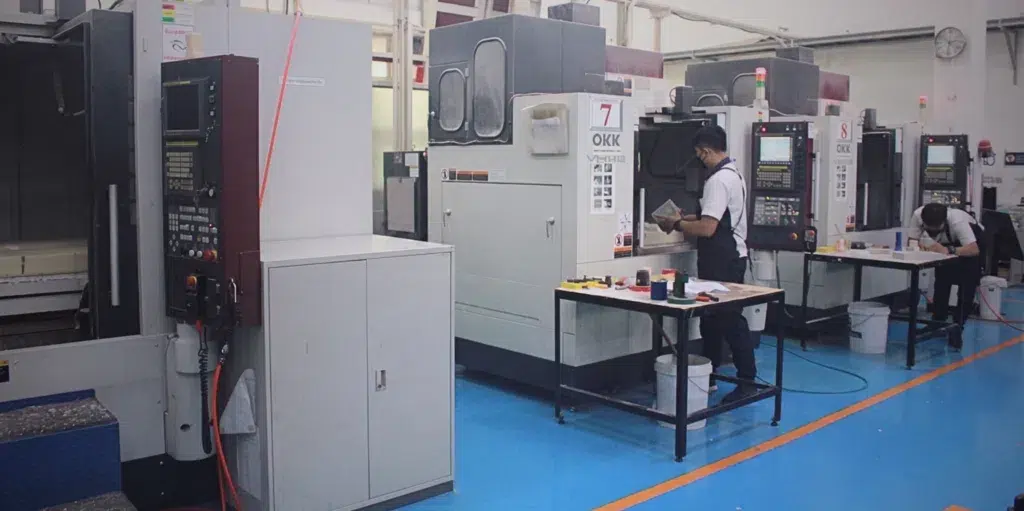
CNC Milling:
- The most widely used CNC process
- Rotating cutting tools remove material from a workpiece across multiple axes
- Common applications include face milling and peripheral milling
- Excels at flat, irregular, or complex geometries
- Best suited for: aerospace and automotive parts requiring tight tolerances
CNC Turning / Lathes:
- The workpiece rotates while the cutting tool moves along its surface
- Excels at round, symmetrical parts
- Best suited for: high-volume symmetrical parts in automotive, oil and gas, and medical manufacturing
CNC Drilling:
- A drill bit moves into a stationary workpiece to create holes
- Used for functional purposes, such as screw bolt openings, as well as aesthetic requirements
- Best suited for: parts across any industry that require precise, repeatable hole placement
CNC Routers:
- Similar to milling, but the workpiece stays fixed while the tool moves across X, Y, and Z axes
- Produces faster cuts than milling
- Best suited for: signage, custom furniture, cabinetry, door carvings, prototyping, and thermoforming trim
CNC Grinders:
- A rotating abrasive wheel removes material from rough surfaces to produce a smooth, finished part
- Best suited for: aerospace turbine blades, automotive crankshafts and camshafts, and medical implants and instruments
CNC Waterjet Cutters:
- A high-pressure water stream cuts through material without heat distortion
- Works on a wide range of materials
- Best suited for: composites, thick metals, aerospace parts, automotive panels, medical devices, and architectural stonework
CNC Plasma Cutters:
- A high-temperature plasma jet cuts through conductive materials, powered by an electrical arc
- Best suited for: structural fabrication, HVAC ducting, automotive repairs, shipbuilding plates, and construction beams
Comparison Table of Different Types of CNC Machines
| Machine Type | How It Works | Excels At | Best Suited For |
| CNC Milling | Rotating tools remove material across multiple axes | Complex, irregular geometries | Aerospace and automotive parts |
| CNC Turning / Lathes | The workpiece rotates while the tool moves along its surface | Round, symmetrical parts | Automotive, oil and gas, and medical parts |
| CNC Drilling | Drill bit cuts into a stationary workpiece | Precise, repeatable holes | Any industry requiring accurate hole placement |
| CNC Routers | The tool moves across X, Y, and Z while the workpiece stays fixed | Fast cuts on flat materials | Furniture, signage, cabinetry, and prototyping |
| CNC Grinders | Abrasive wheel removes material from rough surfaces | Smooth surface finishing | Turbine blades, crankshafts, and medical implants |
| CNC Waterjet Cutters | High-pressure water stream cuts without heat | Heat-sensitive and varied materials | Composites, thick metals, and architectural stonework |
| CNC Plasma Cutters | Plasma jet cuts conductive materials via electrical arc | Fast cutting of conductive metals | Structural fabrication, shipbuilding, and HVAC |
What Products Are Made with CNC Machining?
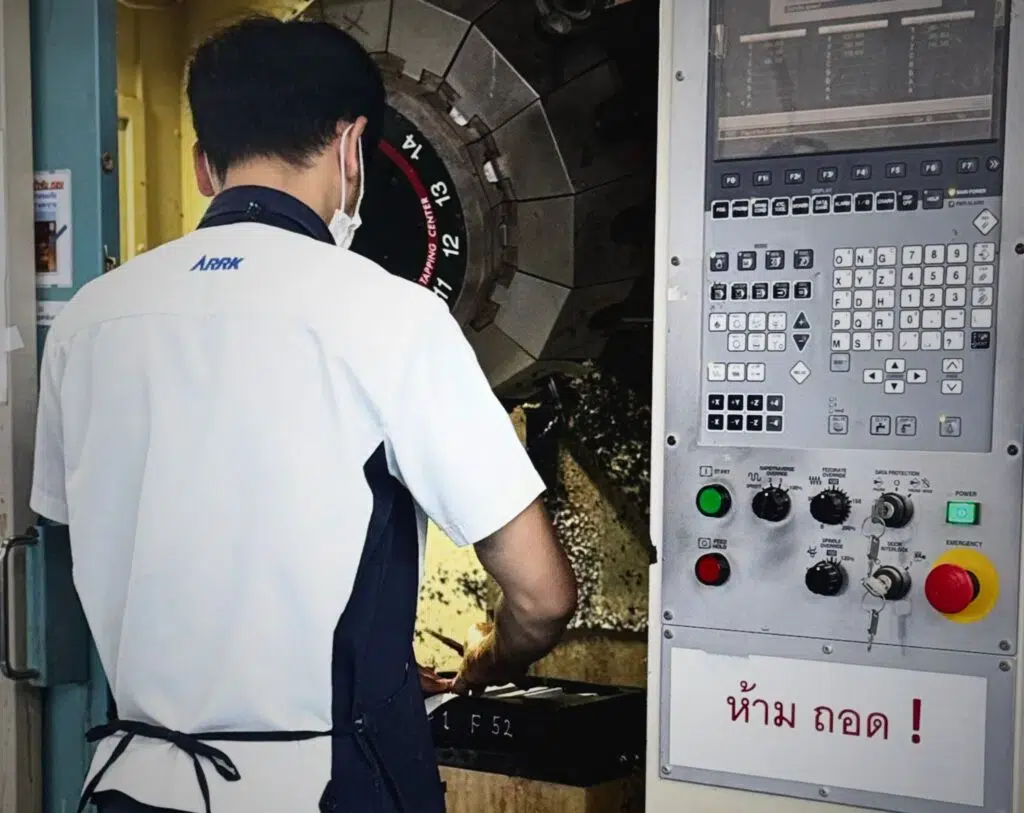
CNC machining supports manufacturing across many industries. Here are some products that are made through CNC machining:
Consumer Electronics
- Laptop enclosures
- Smartphone frames
- Wearable device casings
Automotive Manufacturing
- Engine blocks and cylinder heads
- Gearboxes and transmission parts
- Custom wheels and rims
Aerospace Engineering
- Turbine blades
- Rocket engine components
- Aircraft structural parts
Medical Devices
- Orthopedic implants
- Surgical instruments
- Diagnostic equipment components
Looking for something specific? Explore our full range of precision-engineered components and find out what we can produce for you.
What Materials Can Be Used in CNC Machining?
CNC machining works with a wide range of materials. Here are some of them:
- Metals
- Aluminium
- Steel and stainless steel
- Brass
- Titanium
- Plastics
- Delrin (POM)
- ABS
- Polycarbonate
- Nylon
- Other Materials
- Wood
- Machinable foam
What Are the Material and Design Limitations of CNC Machining?
Some materials and geometries present challenges:
- Soft or flexible materials such as rubber: Difficult to hold in place and prone to deforming under cutting pressure, leading to inaccurate cuts.
- Brittle materials like glass or ceramics: Tend to crack or chip during machining rather than cut cleanly, making precision difficult to achieve.
- Deep cavities, sharp corners, and undercuts: Cutting tools cannot always reach these areas because of the nature of a rotating tool
- Unstable materials that damage tools: Certain composites or abrasive materials rapidly wear down cutting tools, which are not as suitable for CNC machining.
CNC Machining Surface Finishing Options
CNC-machined parts can be surface finished for both aesthetic and functional purposes. Common options include:
- Polishing: Buffs the surface to either a matte or gloss finish. Best suited for prototypes, presentation models, or parts that require clarity and reduced friction.
- Sprayed Texture: Applies a realistic, non-reflective coating that mimics the look and feel of injection-moulded parts. Ideal for consumer product prototypes where a uniform finish is needed.
- Anodising: An electrochemical process that hardens the surface of metal parts, making them more resistant to corrosion. Available in a range of colours.
- Powder Coating: Electrostatically applies a dry polymer resin to metal surfaces, which is then cured under heat. Produces a durable, chip-resistant finish well-suited for metal components.
- Bead Blasting: Propels small glass beads at the surface under high pressure to create a smooth, uniform matte appearance without altering part dimensions. Also prepares surfaces for painting by improving adhesion.
- Painting: Applies colour, texture, and varying gloss levels to replicate the intended look of a final product.
Conclusion
CNC machining delivers high precision, consistent quality, and the ability to produce complex parts with tight tolerances, making it a reliable choice for both prototyping and functional components across industries.
For projects that don’t require mass production, low-volume production (LVP) offers a practical path forward. At ARRK Asia, we combine prototyping expertise with CNC machining capabilities to support this type of flexible manufacturing. Contact us today to find out how we can support your next project.
Frequently Asked Questions (FAQs) About CNC Machining
- Which industries benefit from CNC machining?
Industries such as aerospace, medical, and automotive benefit greatly from CNC machining. It is used to produce high-precision parts like turbine blades, medical implants, prosthetics, engine components, and gears that require tight tolerances. - What specialties does ARRK Asia have in CNC machining?
ARRK Asia specialises in low-volume CNC machining, with strong multi-axis capabilities for prototypes and small batch production. We specialise in industries such as aerospace & defence, automotive, consumer products, industrial, medical, robotics, and transportation across the Asia Pacific region. - What are the five axes on a CNC machine?
The five axes are X, Y, and Z for linear movement, plus A and B for rotational movement. These additional axes allow the machine to approach a part from multiple angles, enabling more complex machining. - What is the difference between CNC and DNC?
CNC controls a single machine using programs stored within the machine. DNC connects multiple machines to a central computer that distributes programs and monitors operations. - What is the difference between CNC milling and a CNC lathe?
CNC milling rotates the cutting tool while the workpiece remains fixed, making it suitable for complex shapes. A CNC lathe rotates the workpiece while the tool remains stationary, making it ideal for cylindrical parts. - What is the difference between CNC and VMC?
CNC encompasses the overall technology of computer-controlled machining. A VMC (Vertical Machining Center) is a specific type of CNC milling machine with a vertically oriented spindle. - What is the difference between CNC and PLC?
CNC controls precise machining movements for manufacturing parts (such as milling and cutting). PLC systems manage automated industrial processes using logical control sequences (like conveyors).