


Introduction
New ideas and innovations are constantly shaping the products we use every day. For many of them to go from concept to reality, a reliable and scalable manufacturing method is needed, and injection moulding has long been that go-to solution.
It is one of the most widely used manufacturing processes in the world, with the Asia Pacific region alone commanding 34.1% of the global market in 2025. In this article, we break down common terms in injection moulding, how it works, and its real-life applications.
What is Injection Moulding?
Injection moulding is a manufacturing process that melts plastic, injects it into a metal mould, and then cools and solidifies it into the desired shape.
Known for its flexibility and cost-effectiveness, it can produce large volumes of parts across a range of materials at a consistently low cost per piece.
The Benefits of Injection Moulding
- High production speed and efficiency: Injection moulding produces parts quickly. This makes it well-suited for mass production runs where thousands of identical parts are needed in a short time.
- Cost-effectiveness at scale: While initial tooling costs are relatively high, the cost per part drops significantly as volume increases. Since most of the process is automated, labour requirements are low, helping reduce overall manufacturing overhead.
- Precision, consistency, and quality: The process delivers tight tolerances and consistent geometry from part to part, making it suitable for complex or safety-critical components.
- Material and design flexibility: Various thermoplastics and some thermosets can be used to adjust properties like strength, flexibility, and heat or chemical resistance. Moulds can also include features like ribs, bosses, snap-fits, and inserts.
- Less wasted material: Most waste comes from the sprue and runners, the channels that guide molten plastic into the mould. These can be reground and recycled, supporting sustainability.
Common Terms to Know in Injection Moulding
Process and Machine Basics
- Clamp force / Tonnage: The force a machine uses to keep the mould tightly closed during injection. It is usually measured in tonnes and helps determine the machine’s size.
- Cycle time: The total time for one production cycle, from mould closing to the next closing. This includes injection, cooling, and ejection.
Mould and Tooling Terms
- Cavity: The hollow space in the mould that shapes the outer surface of the product. A mould can have multiple cavities to produce several parts at once.
- Core: The part of the mould that forms the inner surfaces of the product.
- Ejector pins: Small pins that push the finished plastic part out of the mould after it opens.
- Draft: A slight angle on vertical walls that helps the part release easily from the mould.
Flow and Gate System
- Sprue: The main channel that carries melted plastic from the machine nozzle into the mould.
- Runner: Smaller channels branching from the sprue that guide the plastic to each cavity.
- Hot runner: A heated runner system that keeps plastic molten as it flows, reducing material waste.
- Cold runner: An unheated runner system where plastic hardens and must be removed or trimmed after moulding.
- Gate: A small opening where plastic enters the cavity.
How Does the Injection Moulding Process Work?
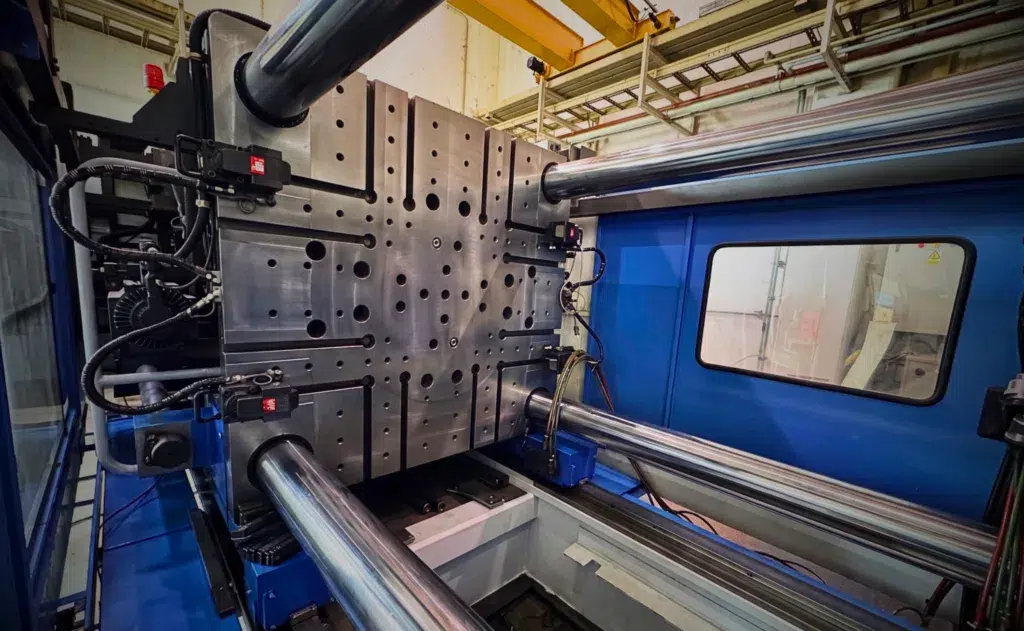
The entire process of injection moulding spans across 5 stages, which are as follows:
- Closure and clamping of the mould
The two mould halves are brought together and held tightly by the clamping unit, creating a sealed cavity that matches the shape of the part. - Melting and measurement of the plastic
Plastic pellets enter the barrel from a hopper, where a rotating screw melts and moves the material forward. The molten plastic is then held in front of the screw until the required volume is ready.
- Injection into the cavity
The screw pushes the molten plastic under high pressure through the nozzle, sprue, runners, and gates into the mould cavity. Injection speed and pressure are controlled to prevent defects, such as short shots or flash.
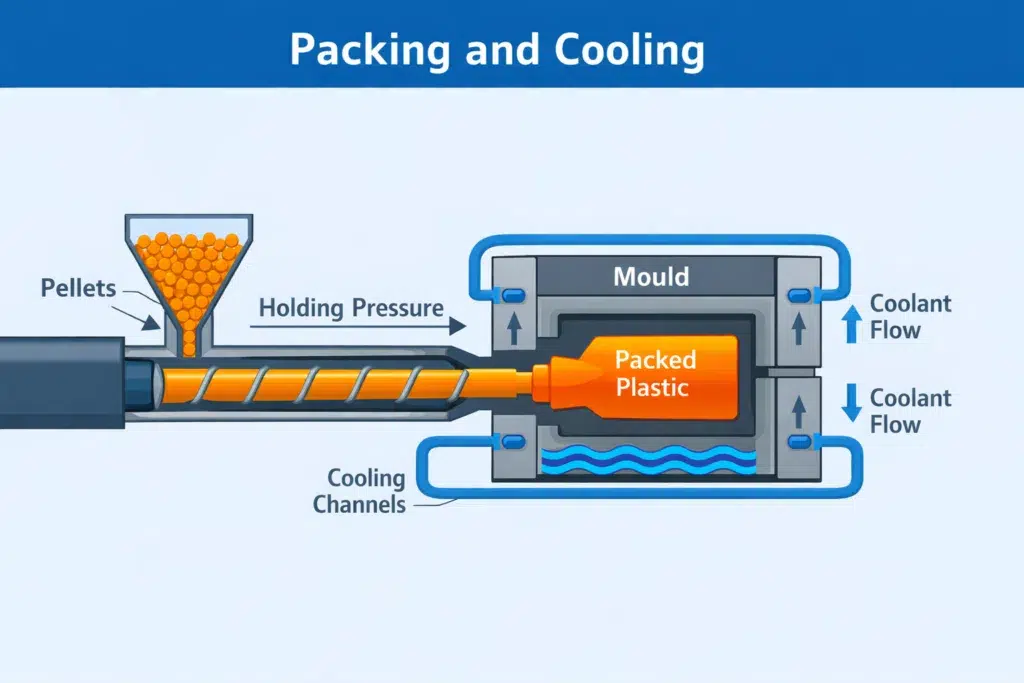
- Packing/dwelling and cooling of the plastic
After the cavity is filled, holding pressure is applied to compensate for shrinkage as the plastic cools. Coolant (air or water) flows through the mould’s cooling channels to solidify the part while the mould remains closed.
- Opening of the mould and ejection
Once the part has cooled sufficiently to maintain its shape, the mould opens, and ejector pins push the part out. The part is then removed, often using robotic handling, before the mould closes to start the next cycle.
Materials Used in Injection Moulding and Their Applications
Although many polymers can be used in injection moulding. The most commonly used materials include:
Thermoplastics
- Polypropylene (PP): Lightweight, chemically resistant. Used in packaging, containers, automotive interiors, and consumer goods.
- Polyethylene (HDPE / LDPE): Tough, flexible, low‑cost. Used in bottles, caps, packaging, and simple housings.
- Acrylonitrile Butadiene Styrene (ABS): Rigid, impact‑resistant, good surface finish. Used in electronics enclosures and automotive parts.
- Polycarbonate (PC): Transparent, strong, heat‑resistant. Used in lenses, clear covers, and safety‑relevant parts.
Elastomers and Flexible Materials
- Thermoplastic Elastomers (TPE) and Thermoplastic Polyurethane (TPU): Rubber‑like, flexible materials used for grips, seals, and soft‑touch over‑moulds.
- Liquid Silicone Rubber (LSR): Highly flexible, heat‑resistant, and biocompatible; common for medical seals, baby‑product nipples, and automotive gaskets.
Specialty and Engineering Materials
- ASA (Acrylonitrile Styrene Acrylate): UV‑resistant, weather‑stable plastic; often used for outdoor housings and exterior automotive or consumer‑product parts.
- PC‑ABS (Polycarbonate‑ABS blend): Combines the impact strength and heat resistance of PC with the easier processing and lower cost of ABS; common in automotive interiors and electronics enclosures.
- High‑performance polymers (PPS, PEEK, PSU/PPSU): High‑temperature and high‑chemical‑resistance materials used in aerospace, medical devices, and demanding engineering applications.
Not sure which material to choose? Partner with our team for a consultation and guidance before production begins.
Types of Injection Moulding Machines
| Machine Type | How it Works | Benefits | Best Suited For | Moulding Technologies / Processes |
| Hydraulic | Uses fluid pressure for injection and clamping. | Strong clamping force, durable, and cost-effective for high-volume production | Automotive parts, large industrial components, thick plastic parts | Gas-assisted moulding, structural foam moulding |
| Electric | Uses servo motors for precise and controlled machine movements. | High precision, energy-efficient, and clean operation | Medical devices, electronics, micro components | Micro moulding, thin-wall moulding |
| Hybrid | Combines hydraulic power with electric control systems. | Balanced performance, improved energy efficiency | Packaging, consumer goods, multi-cavity moulds | Standard thermoplastic moulding, liquid silicone rubber (LSR) moulding |
Types of Injection Moulding Processes
- Standard Injection Moulding
A basic process where molten plastic is injected into a mould, cooled, and then ejected. It is commonly used to produce single-material and single-colour parts. - Two-Shot Moulding
A process where two different materials are injected into the same mould during one production cycle, allowing parts with multiple colours or material properties to be produced in a single step.

- Insert Moulding
A process where plastic is moulded around a pre-placed insert, usually made of metal or another material, creating a strong bond and reducing the need for additional assembly.

- Overmoulding
A process where one material is moulded over an existing part or substrate, often used to add grip, protection, or a soft-touch surface.

- In-Mould Decorating (IMD)
A process where a printed film or decorative layer is placed inside the mould before injection, allowing the design to bond permanently with the part during moulding.

- Thin-Wall Moulding
A process used to produce parts with very thin walls while maintaining strength, commonly used for lightweight packaging such as food containers and electric housing.

- Gas-Assisted Injection Moulding
A process where nitrogen gas is injected into molten plastic to create hollow sections. This helps reduce material usage and improves the surface finish of parts such as handles and panels. - Reaction Injection Moulding (RIM)
A process that mixes reactive chemicals that cure inside the mould. It produces lightweight, impact-resistant parts such as automotive bumpers.
Conclusion
Whether you are just starting out or scaling up, injection moulding takes the complexity out of manufacturing. From simple components to precision parts across a wide range of materials, it is a flexible and convenient process that handles the heavy lifting so you can focus on bringing your product to life.
At ARRK Asia, we make that path even more accessible with Low-Volume Production (LVP) options and no minimum order quantity, all backed by our commitment to quality and precision at every stage. Ready to bring your product to life? Contact us today to get started.
Injection Moulding Process Frequently Asked Questions (FAQs)
- What is the difference between injection moulding and 3D printing?
- Injection moulding: Forms parts by injecting melted plastic into a metal mould cavity under high pressure. The plastic then cools and solidifies into shape. This method is called formative manufacturing because the material is shaped using a mould.
- 3D printing: Builds objects layer by layer by depositing melted plastic from the bottom up. This method is known as additive manufacturing because material is added gradually to create the final part.
- Injection moulding: Forms parts by injecting melted plastic into a metal mould cavity under high pressure. The plastic then cools and solidifies into shape. This method is called formative manufacturing because the material is shaped using a mould.
- What factors influence the quality of injection moulded parts?
Temperature, pressure, cooling time, and mould design are the key factors.
The plastic must be heated to flow properly without degrading, while pressure must be balanced to ensure complete mould filling. Adequate cooling time prevents warping, and a well-designed mould with even wall thickness ensures consistent, distortion-free parts.
- What is the difference between injection moulding and thermoforming?
- Production Process: In injection moulding, melted plastic is injected into a mould to form the part. In thermoforming, plastic sheets are heated until soft and then shaped using vacuum or pressure.
- Tooling: Thermoforming uses a single-sided mould, while injection moulding uses a fully enclosed two-sided mould.
- Materials: Thermoforming shapes heated plastic sheets, while injection moulding uses small plastic pellets that are melted and injected into the mould.
- Production Process: In injection moulding, melted plastic is injected into a mould to form the part. In thermoforming, plastic sheets are heated until soft and then shaped using vacuum or pressure.
- What types of pressure are used in injection moulding?
- Injection pressure: The force used to push molten material into the mould, determined by the size and shape of the part being produced.
- Holding pressure: The pressure applied to the melted resin once the mould is filled is held for a duration based on product requirements.
- Clamping pressure: The force that keeps both halves of the mould closed and sealed throughout the process.
- Back pressure: The pressure applied to ensure consistent pigmentation and even melting of the plastic.
- Nozzle pressure: The pressure inside the nozzle as liquid resin flows toward the mould cavity.
- Injection pressure: The force used to push molten material into the mould, determined by the size and shape of the part being produced.
- Which side of the mould does plastic get injected from?
An injection mould has two halves: the A-side (cavity) and the B-side (core). The A-side is fixed to the machine, while the B-side is attached to the moving clamp. During the moulding process, molten plastic is injected through the A-side cavity into the mould.